Category Archives: Interior Design

Falling Water

Standard

falling water

falling water

Falling water is a famous house designed by Frank Lloyd Wright for the Kaufmann’s. It was a weekend home; the main premise was they loved waterfalls and would like to be part of it. I think just the idea of it was very romantic and maybe that was what magically pulled and drew to the building. I have heard about it in bits and pieces everywhere. The first time I have heard of it was when we were studying for JLPT at my friend’s office and he had a black mug with a red inside, inscribed on the black side was “Falling water” under a few perpendicular lines which looked like the # key. I have also heard about it recently in history class where Frank Lloyd Wright’s brilliance and temperament were described in depth. He was definitely a colorful character with many stories, I was mostly interested in the ukiyoe (Japanese woodblock prints) collection he treasured. Falling water’s structural and composition influences from woodblock paintings are obvious.

It was a rainy day when we were there; we had to use the green umbrellas the organization provided us- no colorful rainbow umbrellas or printed umbrellas were allowed. Perhaps they were distracting and took away from the piece although it was probably for more pragmatic reasons. Entering the house, we noticed how low the ceiling was, how soundproof the windows were, just a small opening of one of the many windows would allow the sound of the streams to enter the room. The furniture were designed for the space, the view was not to be blocked and there was a theme of rock formations and horizontal space Wright would display over and over again.

Honestly, I think the pictures at night on the website look different than the actual structure. When I was there, I was overwhelmed with the sense of serenity from the flow of water, I wish I could enjoy the place more by experiencing and sitting there as it was meant to be, instead of just a tour (I am sure if you pay x amount of money, you could). I admire the consistency of the theme, horizontal visualization and the idea of a house built on a waterfall. To me, it represented an idea similar to a castle in the sky. I think to see the age of the structure and to know it’s imperfect gave it depth. We are all imperfect in our own ways but it doesn’t make us less- it makes us human. Instead of perfectly kept (I wonder if that’s even possible, given the humidity and other environmental factors), it showed that things would eventually succumb and change to natural elements even if the creator or designer was insistent on the minuscule details of the work and tried to control those elements. It’s as though the work itself has a life of its own that will manifest through time. I am sure the foundation did a lot of renovation and maintenance to help slow down the process or restore what was lost, but if you look closely at the beige color on the exterior, it is peeling away, the railing is not the burgundy it once was. And that’s okay. That also makes it beautiful in its own way.

Rendering- Matching Marble with markers and watercolor

Standard

Our next project in class was to match marble with markers and watercolors. The technique and trick to it is, all the elements I lack in my personality, patience, spontaneity, letting go and minimal control.

marble rendering

The reason for this is when you do the lines for the marbles, you hold the high point or tip of your pencil to let it spontaneously trail off the paper. As for the watercolor portion, you use a ton of water, let it dry and flow.

My teacher is great with it, she does it so naturally with seemingly no effort and as it dries, it looks like it has depth and full of bright color. I am still an amateur who’s reluctant to give up. 🙂

Matching Wood in markers and watercolor

Standard

Another class project was to match wood with markers and watercolor. We used prismacolor markers which is a transparent but permanent marker. Marker paper is special in a way if you want to add color, you can color in the back as well. To create the wood texture, you need to use the marker vertically, layered with base color gray, additional colors as needed, and use color pencils to draw the grain. The colors were really hard to match; you would always use markers first because with watercolors, you can create infinite colors but with markers, the probabilities are somewhat limited (as per my teacher).

wood rendering
Top marker, bottom watercolor in three different shades.

If you have the right guidance, it is achievable-never perfect but still nice.

Rendering- Watercolor vs Fabric

Standard

I haven’t been updating the blog much due to nostalgia of Japan. The culture has fascinated me for many years and the experience of being there was surreal; it left me feeling empty when I came back because the dream or vacation had to end at some point. Instead of thinking of these emotions, I was just going about my daily life which consisted of a 9-5 job, study group for JLPT N4 (we are so unmotivated), Japanese class and last but least, interior rendering class.

The first project we had to do in class was find a floral fabric pattern and copy it exactly on watercolor paper to be filled in with watercolor. It should be an exact duplicate; the only difference should be the white background vs any other color background you had on your fabric.The drawing is easy since we used carbon paper to trace but matching colors on two different mediums is not the same. In garment production, we often send artworks to factory on paper with fabric swatches and expect them to match it by submitting strike offs (screen prints on fabric); if one expects it to match exactly, one is naive. on two different material, due to lighting, weaves, materials, reflections of light, it is impossible. Paper is not fabric afterall and they have different material properties.

Here is my try on it! Not perfect but, as we love to say in production after the 3rd attempt, Best Can Do!
IMG_0841

Disclaimer- Please note I do not own the print- This is for a class project only 🙂

Frick Gallery Drawings

Standard

Sorry for being MIA, but classes have been overwhelming lately. Drawing is actually very time consuming, you look at the clock and realize a few hours have passed by. Or you can procrastinate and think you can finish in an hour then realize, setting up the paper takes half an hour.

We went to the Frick gallery for our final project.

Frick Gallery Drawing

Freehand sketch at Frick Gallery- 2 point perspective- Boucher Room

Frick Gallery Drawing
Completed- Perspective Drawing with rulers and t-square

Frick Gallery Drawing
Freehand Sketch at Frick Gallery- 1 point perspective- Garden Court

Frick Gallery Drawing
Completed- Perspective Drawing with rulers and t-squares

It’s not really a matter of how well you draw; it’s really about how much time you’re willing to spend and how much practice you get! Still need a lot of practice. There are things I avoid because I am not good at; such as opened doors and window scenes.

Perspective drawings

Standard

I spent most of my weekend trying to figure out how to do this.

one point perspective
One point perspective of an interior- Vanishing point in the center, station point is wherever you want to put it, it will be the scope of what you see within an interior.

2 point perspective
Two point perspective- two vanishing points- left vanishing point and right. Everything has to be parallel and the lines will converge to create the shapes and forms.

Looks simple but took me forever!!

Two point perspective of a chair and etc

Standard

For a two point perspective to work and to make it as painless as possible, you position the paper horizontally so your 2 vanishing points can be as far apart as possible. All the lines are parallel as you converge the lines from left to right.

Here is an example of a chair I had to draw for class:
IMG_5736

There are times when my free flow drawings are better than measured one because there is less restrictions. But the perspective is totally off in some angles; noticeably.
IMG_5782
From observation only

IMG_5781
Using perspective and rulers

Perspective is really fun when you get it, when you dont, it’s a nightmare and you want to pull out your hair! Most of the time, it’s the latter for me.

Perspective Drawing- Room

Standard

I have been busy with classes; it’s taken up most of my life and in addition to that, my long commute doesn’t make things easier. For one of my classes, I had to draw a one point perspective of any room in my house. Since my room is extremely cluttered with miscellaneous items, I omitted a few furnitures (heh!) and items. My professor said I should get a chair!

IMG_5658
If you’re wondering what the items are on the foreground, it’s my fossil crossbody bag and my panel heater.

One point perspective is not difficult once you understand the concept. Basically, it is the position of which the viewer is looking at. Easy way to explain it is say, you’re 5’10”, your horizontal line would be around 5’8″ (of course this depends on where your eye level is, horizontal line= eye level), and the vanishing point is the point of which all recedes. My vanishing point is the dot in the middle of the bookshelf. If you use a ruler, all receding lines will connect to the Vanishing point, giving the drawing depth even without shading. It’s pretty neat. Of course, I am oversimplifying it.

Happy Wednesday! Hope you braved the cold 🙂

Final Drafting Project

Standard

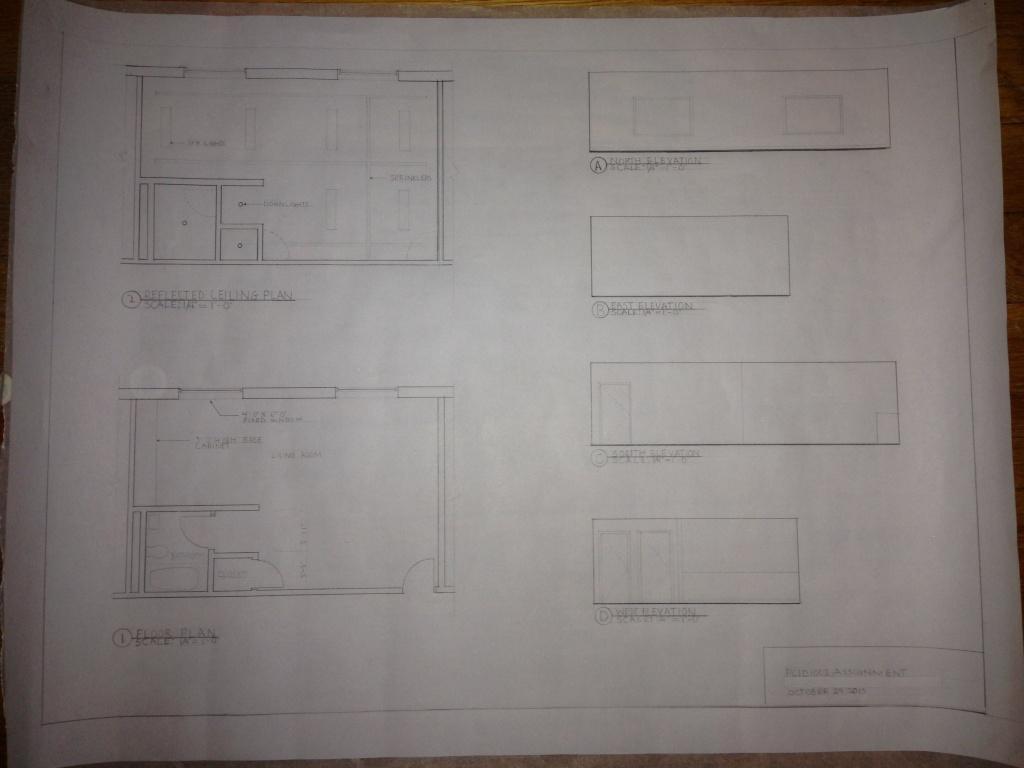
Tuesday was the last day of class and the day we had to turn in our final project. The project was to first survey the classroom, draft a floor plan, ceiling plan and elevations, then envision the space as something else.

As usual, I immersed myself so much into the research and the purpose of the space that I forget it is a drafting class and not a design class.

My concept was to combine the traditional Japanese tea house with the westernized Japanese cafe called Kissaten. A standard tea room is 4 1/2 tatami mat with a hearth in the center. The outside of the room will be representational of the exterior of a traditional tea house; shouji windows which will let the natural light flow through yet give the users privacy inside.

The entrance flows clearly for those who want to use the tearoom or the bar at the kissaten.

final project

Final project- Kissaten x tearoom

Actually for this class, the line quality is more important than the concept. While I have more control of the lines, I still need to improve on the lettering (a bit too big) and improve the boldness of lines for the interior. There is so much more to learn. It is one of those classes where you may not find it useful in the future in a pragmatic way but it teaches you patience you never thought you had; I was also impressed with the compassion of our teacher who understood that trying is just as important as making it perfect. Some people came in with the final project on trace paper instead of vellum while we also had an overachiever who had drawn a 3D version of it. All walks of life, but we all tried and perhaps that’s what matters.